 Pocket Panchangam
Bhadrapada masam · a Telugu-home festival
Vinayaka Chavithi
Sri Varasiddhi Vinayaka · About 60 minutes · 17 steps
When is it?
- Our app's date
- TTD panchangam
The vidhanam at a glance
- Getting ready
- Make sure the items are ready
- Light the lamp
- Achamanam
- Sankalpam
- Inviting him
- Vastram
- Gandham, turmeric and kumkuma
- Yajnopavitam
- Durva or garika
- The twenty-one leaves
- The 108 names
- Naivedyam
- Vinayaka Chavithi vrata katha (the birth of Vinayaka)
- Vinayaka Chavithi vrata katha (the Syamantaka story)
- Prarthana
- Harathi
Dates are computed by our own panchangam engine, which matches the TTD Srivari calendar to the minute. This vidhanam has been checked by our గురువుగారి.
This is a festival puja for the whole family to do together. No priest at hand? No worry — this guide walks beside you at every step, telling you what to do in plain words, with every mantra in your own script. You don't need everything on the list — done with devotion, whatever you have is festival enough for the Lord.
The best time is after your morning bath, before noon. Allow about an hour for the puja — an hour and a half with the story. The udvasanam belongs to the day of the immersion.
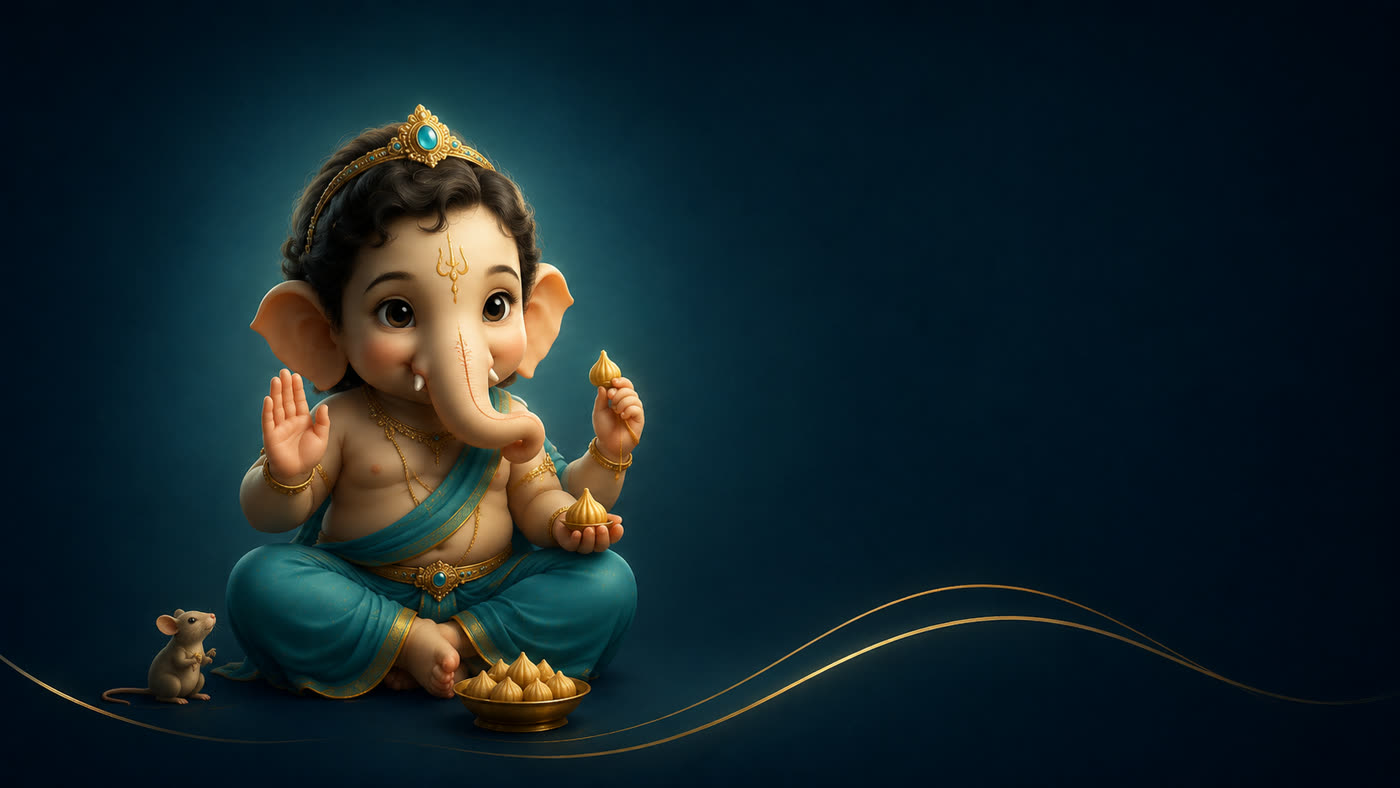
The full vidhanam
Getting ready
- Clean the place where you will do the puja, and spread a fresh cloth over the seat.
- Place a natural clay Vinayaka on the seat, and decorate him with flowers, leaves or decorations you can use again.
- Keep everything the puja needs within reach — the samagri, flowers, garika, patri, fruits and naivedyam.
- 🌿 A note for nature: instead of plastic flowers, thermocol and glitter decorations, choose natural ones or ones you can use again.
Make sure the items are ready
- Before you step into the puja, take one look — the everyday puja items and the checklist items, all of them or as many as you could manage, are they in place?
- If you'd like to look through them, tap the checklist button below; if you don't need to, we'll move ahead.
Light the lamp
- Light the lamp in the puja space.
Shlokaśubhaṃ karoti kal̤yāṇaṃ ārogyaṃ dhanasaṃpadaḥ | śatrubuddhi vināśāya dīpajyoti namostute ||
Achamanam
- Take a little water in your right hand, and sip a little after each mantra.
Shlokaoṃ keśavāya svāhā | oṃ nārāyaṇāya svāhā | oṃ mādhavāya svāhā |
Sankalpam
- Take a few akshatas and a little water in your hand, and make your resolve with devotion:
- “On this day of Sri Vinayaka Chavithi, for the wellbeing, health, peace and good fortune of my family, I worship Sri Vinayaka Swami with devotion.”
- Then let the akshatas fall into the puja plate.
Inviting him
- Offer a flower or akshatas as you invite Vinayaka with devotion.
Shlokaoṃ gaṃ gaṇapataye namaḥ | āvāhayāmi ||
Vastram
- If you have a small cloth for Vinayaka, dress him in it.
- If not, offer a clean new cloth before him.
Shlokaoṃ śrī gaṇeśāya namaḥ | vastraṃ samarpayāmi ||
Gandham, turmeric and kumkuma
- Offer sandal paste to Vinayaka.
- Then offer turmeric and kumkuma.
Shlokaoṃ śrī gaṇeśāya namaḥ | gaṃdhaṃ samarpayāmi ||
Yajnopavitam
- Offer the sacred thread to Vinayaka. Place it over his left shoulder so that it falls down to the right.
- If you can put it on the murti, do so. If not, offer it before him.
Shlokaoṃ śrī gaṇeśāya namaḥ | yajñopavītaṃ samarpayāmi ||
Durva or garika
- Offer clean garika to Vinayaka with devotion.
Shlokaoṃ gaṃ gaṇapataye namaḥ | dūrvāṃkurān samarpayāmi ||
The twenty-one leaves
- Tradition worships him with twenty-one kinds of leaves on Vinayaka Chavithi.
- Even if all twenty-one are not to be found, you can carry on with devotion using twenty-one durva.
Shlokaoṃ sumukhāya namaḥ | mācīpatraṃ pūjayāmi || oṃ gaṇādhipāya namaḥ | bṛhatīpatraṃ pūjayāmi || oṃ umāputrāya namaḥ | bilvapatraṃ pūjayāmi || oṃ gajānanāya namaḥ | dūrvāyugmaṃ pūjayāmi || oṃ harasūnave namaḥ | dattūrapatraṃ pūjayāmi || oṃ laṃbodarāya namaḥ | badarīpatraṃ pūjayāmi || oṃ guhāgrajāya namaḥ | apāmārgapatraṃ pūjayāmi || oṃ gajakarṇāya namaḥ | tulasīpatraṃ pūjayāmi || oṃ ekadaṃtāya namaḥ | cūtapatraṃ pūjayāmi || oṃ vikaṭāya namaḥ | karavīrapatraṃ pūjayāmi || oṃ bhinnadaṃtāya namaḥ | viṣṇukrāṃtapatraṃ pūjayāmi || oṃ vaṭave namaḥ | dāḍimīpatraṃ pūjayāmi || oṃ sarveśvarāya namaḥ | devadārupatraṃ pūjayāmi || oṃ phālacaṃdrāya namaḥ | maruvakapatraṃ pūjayāmi || oṃ heraṃbāya namaḥ | siṃdhuvārapatraṃ pūjayāmi || oṃ śūrpakarṇāya namaḥ | jātīpatraṃ pūjayāmi || oṃ surāgrajāya namaḥ | gaṃḍakīpatraṃ pūjayāmi || oṃ ibhavaktrāya namaḥ | śamīpatraṃ pūjayāmi || oṃ vināyakāya namaḥ | aśvatthapatraṃ pūjayāmi || oṃ surasevitāya namaḥ | arjunapatraṃ pūjayāmi || oṃ kapilāya namaḥ | arkapatraṃ pūjayāmi || oṃ śrī gaṇeśvarāya namaḥ | ekaviṃśati patrāṇi pūjayāmi ||
The 108 names
- Recite the 108 names of Sri Vinayaka, offering a flower or akshatas with each one.
Naivedyam
- Offer Vinayaka whatever naivedyam you were able to make.
- Then offer a little water.
Shlokaoṃ gaṃ gaṇapataye namaḥ | naivedyaṃ samarpayāmi ||
Vinayaka Chavithi vrata katha (the birth of Vinayaka)
- Before the story, hold a few akshatas in your hand. When it ends, place them on your head.
- ⏩ If the telling feels slow, the ×1 button below changes the speed.
- For the vratam, the Syamantaka story alone is enough — this birth katha is for his greatness. Short on time, you may skip this part.
Vinayaka Chavithi vrata katha (the Syamantaka story)
- Before the story, hold a few akshatas in your hand. When it ends, place them on your head.
- ⏩ If the telling feels slow, the ×1 button below changes the speed.
- Now read or listen to the Syamantaka story — this is the heart of the vratam.
- This is the vratam's main katha — hearing or reading it is the essential part. Hold akshatas as you listen; place them on your head when it ends.
Prarthana
- Fold your hands and pray to Vinayaka.
- Then tell him about your family, your health, your studies, your work or your wishes — in your own words. ❤️
- And after that, pray not only for yourself but, selflessly, for the wellbeing of the whole world.
Shlokatatpuruṣāya vidmahe vakratuṃḍāya dhīmahi | tanno daṃtiḥ pracodayāt || sarve janāḥ sukhino bhavaṃtu ||
Harathi
- Offer harathi to Vinayaka with the lamp or with camphor.
- Take the harathi to your eyes and fold your hands.
Shlokaoṃ gaṃ gaṇapataye namaḥ | nīrājanaṃ samarpayāmi ||
Udvasana & nimajjanam
Udvasanam
- On the day of the immersion, offer Vinayaka the lamp, incense, flowers and naivedyam, and give him harathi.
- Then fold your hands and pray to him lovingly:
- “Vinayaka… accept our worship and bless us. Return now to your own place, and come again to our home next year.” ❤️
- Say this mantra as you offer akshatas or a flower.
- Then bow to him and carry him to the immersion.
The puja things, afterwards
- 🌺 For as many days as your family keeps Vinayaka at home, you can simply offer the lamp, incense, flowers, naivedyam and harathi each day.
- ♻️ Flowers, patri and garika — compost them if you can, or put them out as biodegradable wet waste.
- 🌊 Please do not put them in ponds, canals or rivers because “they are natural anyway”. Flowers and leaves ARE natural, but in large quantities they take the oxygen out of the water as they decay. Fish and other water creatures then struggle to breathe, the water quality falls, and the oil, kumkuma, colours and thread that go in with the flowers harm them further.
- Eco-friendly does not mean putting natural things into water — it means returning them to the earth without harming her. 🌿
- 🍎 Fruits, the coconut and the naivedyam — take them as prasadam and share them.
- ✨ Decorations — keep them for the next puja.
The immersion, gently
- 🌿 If your Vinayaka is of natural clay, you can immerse him at home in a large vessel if that works for you — and afterwards give that water to your plants.
- 🌊 If you immerse him outside, please use the designated eco-friendly immersion ponds.
- 🚫 Flowers, plastic covers, thermocol and cloth decorations — do not put these into the water.
- ❤️ We invited Vinayaka home with love. We worshipped him with flowers. We offered him naivedyam. We gave him harathi.
- And when we say goodbye to him too… if we take care that his creation comes to no harm, that is the most beautiful ending our puja can have. 🌿❤️
- Let us worship Vinayaka. And let us honour Vinayaka's creation.
- 🙏 Ganapati Bappa Morya!
Puja checklist
🪔 Everyday puja items
- Turmeric
- Kumkuma
- Sandal paste
- Akshatas
- Plates to stand the lamps on
- Cotton wicks
- Oil or ghee
- Camphor
- Incense sticks
- Matchbox
- Bell
- Arati plate
- Water vessel for the puja
- Small bowls
- Spoon
- Thread
- Uddharini (small ladle)
🪷 Vinayaka and the puja seat
- A natural clay Vinayaka
- Puja seat
- A clean cloth to spread on the seat
- A small cloth for Vinayaka
- Sacred thread
- Palavelli canopyOptional
🌺 Flowers, patri, fruits and tamboolam
- Flowers
- A flower garlandOptional
- Garika (durva grass)
- The twenty-one kinds of patriOptional
- Mango leaves and toranamOptional
- Bananas
- Whatever other fruits you haveOptional
- Coconut
- Betel leaves
- Areca nuts
🍚 For the naivedyam
- UndralluOptional
- Kudumulu and modakamOptional
- JaggeryOptional
- PayasamOptional
- PanakamOptional
- Chalimidi and vadapappuOptional
- Any other prasadam made at homeOptional
🌿 The twenty-one leaves
- Machi leafOptional
- Vakudu leaf (Bruhati)Optional
- Bilva (Bael)Optional
- Garika (Durva grass)Optional
- Ummetta (Datura)Optional
- Regu (Jujube)Optional
- Uttareni (Apamarga)Optional
- TulasiOptional
- MangoOptional
- Ganneru (Oleander)Optional
- VishnukrantaOptional
- PomegranateOptional
- Devadaru (Deodar)Optional
- Maruvam (Marjoram)Optional
- Vavili (Vitex)Optional
- Jaji (Jasmine)Optional
- Devakanchanam (Gandaki)Optional
- Jammi (Shami)Optional
- Ravi (Peepal)Optional
- Maddi (Arjuna)Optional
- Jilledu (Arka)Optional
Prasadam
Undrallu, kudumulu and modakam
These are the first things that come to mind for Vinayaka Chavithi naivedyam.
Payasam, panakam, chalimidi, vadapappu
Only whichever of these you are able to make — that is enough.
Jaggery, or any prasadam made at home
Offer Vinayaka whatever naivedyam you were able to make.
📖 Vrata katha — the birth of Vinayaka
🌿 The greatness of the Vinayaka vratam, as told by Suta Maharshi
Long ago, Dharmaraja lost his kingdom and all his wealth, and was living in the forest with Draupadi and his brothers. One day he came to Naimisharanya.
There he saw Suta Maharshi, who was explaining many secrets of the puranas to Shaunaka and the other sages, and bowed to him.
“Maharshi… we have lost our kingdom and all our wealth. If there is a vratam by which these troubles would leave us and our former glory return, please tell us,” he prayed.
Then Suta Maharshi began to tell Dharmaraja the greatness of the Sri Vinayaka vratam.
🐘 Gajasura's penance — the boon Lord Shiva gave
Long ago there was a demon named Gajasura. He performed a terrible penance for Lord Shiva.
Pleased with his penance, Shiva appeared and said, “Gajasura… ask for whatever boon you wish.”
Gajasura bowed to Shiva and asked, “Lord… may you always dwell within my stomach.”
Unable to refuse a devotee's wish, Shiva entered Gajasura's stomach.
❤️ The plan Sri Hari made to bring Shiva back
In Kailasa, Parvati Devi did not know where Shiva was. However much she searched, he could not be found.
At last she learned that Shiva was inside Gajasura's stomach. Not knowing how to bring him out, she prayed to Sri Mahavishnu.
Vishnu reassured Parvati Devi and called Brahma and the other gods. Then a plan was thought of.
Nandi, Shiva's mount, was decorated as a performing bull. Brahma and the other gods took up instruments.
Sri Mahavishnu himself became the one leading the bull troupe, and together they all went to Gajasura's kingdom.
Before Gajasura they made Nandi dance most wonderfully. Watching that performance Gajasura was delighted and said, “Ask for whatever you want. I will give it.”
Then Sri Hari said, “This bull is no ordinary one. This is Nandi, Shiva's mount. He has come searching for his lord. Give Shiva back.”
At those words Gajasura understood that the one before him was Sri Mahavishnu. He realised that his death was certain.
Then, praying to the Shiva within his own stomach, he asked, “Lord… let my head be worshipped in all three worlds. Let my hide be worn by you.”
Shiva granted that boon. Nandi tore open Gajasura's stomach with his horns, and Shiva came out. Then Shiva set out for Kailasa.
🌺 How the boy Parvati Devi made became Gajanana
Learning that Shiva was returning, Parvati Devi was very glad.
As she was preparing to bathe, from the turmeric paste applied to her body she shaped the form of a small boy, and with her own power gave him life.
She stood the boy at the door and said, “Until I say so, let no one come inside.”
As his mother had told him, the boy stood guard there.
Just then Shiva reached Kailasa. As he went to step inside, the boy stopped him.
The boy did not know who stood before him. He knew only one thing — that his mother's word must be kept.
However much Shiva said, the boy would not give way. In a surge of anger Shiva severed the boy's head with his trident and went inside.
A little later, while speaking with Parvati Devi, the matter of the boy came up. Learning what had happened, Parvati Devi grieved deeply.
Shiva remembered the boon he had given Gajasura. He brought Gajasura's head, set it on the boy's body, and gave him life again.
And so that boy became Gajanana. ❤️
Parvati and Parameshwara raised him as their own son with great love. Gajanana took as his mount a mouse named Anindya.
Afterwards Kumaraswamy was born to Parvati and Parameshwara.
👑 How Gajanana became the lord of obstacles
One day the gods and sages came to Shiva and asked, “Please appoint a lord over obstacles.”
Both Gajanana and Kumaraswamy wished for that place.
Then Shiva set a test. “Whichever of you bathes in all the sacred rivers of the three worlds and comes back to me first shall be the lord of obstacles,” he said.
Kumaraswamy at once set off on his peacock mount.
Gajanana, however, bowed to his father and asked, “Father… how can I travel to all those rivers so quickly? Show me a way.”
Then Shiva explained to him the greatness of the Narayana mantra and gave him its initiation. Gajanana chanted that mantra with devotion.
A wonder happened. Whichever sacred river Kumaraswamy reached… Gajanana was already there before him.
In the end, by the time Kumaraswamy returned to Kailasa, Gajanana was already beside Shiva.
Understanding his elder brother's greatness, Kumaraswamy bowed and said, “My brother alone is worthy of this lordship.”
And so, on the day of Bhadrapada Shuddha Chavithi, Gajanana became the lord of obstacles. From then on he became Vighneshwara. ❤️
🌙 The moon's laughter — Parvati Devi's curse
In the joy of his becoming lord of obstacles, the gods and devotees offered Vinayaka many kudumulu, undrallu, fruits, panakam and vadapappu as naivedyam.
Vinayaka received them happily. Some he ate… some he gave to his mouse… and some he carried in his hand as he reached Kailasa.
He bent to bow to his parents. But with his stomach so full, bending became difficult.
The moon, seated on Shiva's head, saw that sight and laughed mockingly.
The moment the moon's glance fell on him, Vinayaka's stomach burst, all the kudumulu he had eaten came out… and Vinayaka lost his life.
Seeing her son in that state, Parvati Devi in her grief cursed the moon. “Because of your glance my son has come to this. From now on, whoever looks at you will suffer false blame,” she said.
Afterwards Brahma came to Kailasa with the other gods, gave Vinayaka life again, and prayed to Parvati Devi to take back the curse she had given the moon.
Parvati Devi was glad that her son had come back to life. And so she lessened the severity of the curse on the moon.
She said, “Only on this one day on which my son died by the moon's glance — the day of Bhadrapada masam, Shukla Chavithi — will this curse fall on those who look at the moon.”
From then on people began to keep the custom of not looking at the moon on Vinayaka Chavithi. Some time passed this way.
💎 The Syamantaka story (the main katha)
Read (53)
📖 The story of the Syamantaka jewel
In the Yadava clan there were two brothers, Satrajit and Prasena.
Satrajit worshipped Surya, the Sun god, with great devotion. Pleased with his devotion, Surya one day gave him a divine gem called the Syamantaka mani.
That jewel was said to hold great power. Wherever it stayed, wealth and wellbeing followed. Every day it gave a great measure of gold as well. But there was one rule — whoever wore it had to remain clean and disciplined.
One day, as Satrajit came along the streets of Dwaraka wearing the jewel at his neck, the people who saw its blaze thought Surya himself was coming.
Sri Krishna, learning about the jewel, felt: “A gem this powerful would serve the people and the kingdom best if it stayed with King Ugrasena.”
But Satrajit, on hearing this, gave the jewel to his younger brother Prasena instead.
One day Prasena went hunting in the forest wearing the Syamantaka jewel at his neck.
There a lion attacked and killed him. Then Jambavanta slew that lion. Seeing the Syamantaka jewel beside the lion, he carried it to his cave and gave it to his little son as a plaything.
When Prasena did not return, Satrajit grew anxious. And since the Syamantaka jewel he carried was missing too, he suspected: “It must be Krishna who killed Prasena for the jewel.”
That word spread through all of Dwaraka.
With blame falling on him for a wrong he had not done, Sri Krishna resolved to find out the truth.
Taking a few men with him, he went into the forest and searched for Prasena's trail. There Prasena's body was found — and beside it, the pawprints of a lion.
Following them, he found the lion lying dead. From there another set of footprints led to a cave.
Sri Krishna went into that cave alone.
There he saw a small boy playing with the Syamantaka jewel — his elder sister Jambavati beside him.
Just then Jambavanta arrived. Thinking Krishna had come to take the jewel away, he rose to fight him.
Between the two a fierce battle raged for twenty-one days.
At last, one thing became clear to Jambavanta.
He realised that a man who could fight him this many days was no ordinary man. The Lord he had once served as Sri Rama had now come as Sri Krishna — knowing this, he bowed to him.
Begging forgiveness for his mistake, he gave the Syamantaka jewel to Sri Krishna. He also gave his daughter Jambavati — who had admired Sri Krishna from the moment she saw him — to him in marriage.
Sri Krishna returned to Dwaraka with the Syamantaka jewel.
When Satrajit learned the truth of what had happened, he was deeply pained.
He begged forgiveness for having blamed Sri Krishna without cause. He gave his daughter Satyabhama to Sri Krishna in marriage. He wished to give the Syamantaka jewel to Krishna as well.
But Sri Krishna did not take the jewel. “It is yours,” he said, and gave it back to Satrajit.
Some time later, while Sri Krishna was away from Dwaraka, another incident took place.
Listening to the words of a few who were already unhappy over Satyabhama's marriage, Shatadhanva killed Satrajit and carried off the Syamantaka jewel.
He then left the jewel hidden with Akrura.
When Sri Krishna came to know of this, he returned, consoled Satyabhama, and with Balarama went after Shatadhanva.
In the end Sri Krishna caught Shatadhanva and slew him.
But search as he might, the Syamantaka jewel was nowhere on him.
With that, doubt rose even in Balarama. “You found the jewel yourself. Perhaps you have hidden it without telling me,” he said, suspecting Sri Krishna, and went away from there.
Though he had done no wrong at all, blame had come upon Sri Krishna yet again. Why does this keep happening, one after another? — Sri Krishna wondered.
Then Narada Maharshi told him the real reason.
🌙 The story of Vinayaka and the moon
It was the story of how the moon had laughed at Lord Vinayaka — and of the curse Mother Parvati gave him for it.
Narada told Sri Krishna what it means to see the moon on Bhadrapada Shukla Chavithi, and explained: “You too might have seen the moon that day. That is why blame after blame has come upon you for wrongs you never did.”
Then Sri Krishna remembered that he had indeed seen the moon on Bhadrapada Shukla Chavithi. So he prayed to Vinayaka.
Vinayaka appeared before him and blessed him: the blames that had come upon Sri Krishna would fall away.
Then Sri Krishna asked one thing: “If this could happen even to me, what of the ordinary people who look at the moon unknowingly?”
Then Vinayaka gave a boon to everyone.
He gave this boon: whoever sees the moon on Vinayaka Chavithi day, knowingly or unknowingly, will suffer no undeserved blame if they worship Vinayaka and listen to this story of the Syamantaka jewel.
Afterwards Akrura returned to Dwaraka. The truth that the Syamantaka jewel had been with him all along became known to everyone.
With that, the doubts that had fallen on Sri Krishna were cleared away completely.
The story tells that while the Syamantaka jewel remained with Akrura, he used the wealth it brought for good works.
🙏 The shloka to say if you see the moon by mistake
simhah prasenam avadhit simho jambavata hatah | sukumaraka ma rodih tava hy esha syamantakah ||
🙏 The counsel Suta Maharshi gave Dharmaraja at the end
Having told this whole story, Suta Maharshi counselled Dharmaraja: “You too keep the Sri Vinayaka vratam with devotion. Your obstacles will fall away, and victory will come.”
Dharmaraja duly worshipped Vinayaka and kept the vratam. In time he overcame his troubles and won back his kingdom.
So the Sri Varasiddhi Vinayaka vratam — which removes obstacles and grants success — has come down through the generations. ❤️
🙏 Om Gam Ganapataye Namah
🙏 Victory to Sri Varasiddhi Vinayaka Swami
Sri Vinayaka ashtottara shatanamavali
Read the full namavali (108)
oṃ gajānanāya namaḥ
oṃ gaṇādhyakṣāya namaḥ
oṃ vighnarājāya namaḥ
oṃ vināyakāya namaḥ
oṃ dvaimāturāya namaḥ
oṃ dvimukhāya namaḥ
oṃ pramukhāya namaḥ
oṃ sumukhāya namaḥ
oṃ kṛtine namaḥ
oṃ supratīpāya namaḥ
oṃ sukhanidhaye namaḥ
oṃ surādhyakṣāya namaḥ
oṃ surārighnāya namaḥ
oṃ mahāgaṇapataye namaḥ
oṃ mānyāya namaḥ
oṃ mahākālāya namaḥ
oṃ mahābalāya namaḥ
oṃ heraṃbāya namaḥ
oṃ laṃbajaṭharāya namaḥ
oṃ hrasvagrīvāya namaḥ
oṃ mahodarāya namaḥ
oṃ madotkaṭāya namaḥ
oṃ mahāvīrāya namaḥ
oṃ maṃtriṇe namaḥ
oṃ maṃgal̤asvarāya namaḥ
oṃ pramathāya namaḥ
oṃ prathamāya namaḥ
oṃ prājñāya namaḥ
oṃ vighnakartre namaḥ
oṃ vighnahaṃtre namaḥ
oṃ viśvanetre namaḥ
oṃ virāṭpataye namaḥ
oṃ śrīpataye namaḥ
oṃ vākpataye namaḥ
oṃ śṛṃgāriṇe namaḥ
oṃ āśritavatsalāya namaḥ
oṃ śivapriyāya namaḥ
oṃ śīghrakāriṇe namaḥ
oṃ śāśvatāya namaḥ
oṃ balāya namaḥ
oṃ balotthitāya namaḥ
oṃ bhavātmajāya namaḥ
oṃ purāṇapuruṣāya namaḥ
oṃ pūṣṇe namaḥ
oṃ puṣkarotkṣiptavāriṇe namaḥ
oṃ agragaṇyāya namaḥ
oṃ agrapūjyāya namaḥ
oṃ agragāmine namaḥ
oṃ maṃtrakṛte namaḥ
oṃ cāmīkaraprabhāya namaḥ
oṃ sarvasmai namaḥ
oṃ sarvopāsyāya namaḥ
oṃ sarvakartre namaḥ
oṃ sarvanetre namaḥ
oṃ sarvasiddhipradāya namaḥ
oṃ sarvasiddhaye namaḥ
oṃ paṃcahastāya namaḥ
oṃ pārvatīnaṃdanāya namaḥ
oṃ prabhave namaḥ
oṃ kumāragurave namaḥ
oṃ akṣobhyāya namaḥ
oṃ kuṃjarāsurabhaṃjanāya namaḥ
oṃ pramodāya namaḥ
oṃ modakapriyāya namaḥ
oṃ kāṃtimate namaḥ
oṃ dhṛtimate namaḥ
oṃ kāmine namaḥ
oṃ kapitthapanasapriyāya namaḥ
oṃ brahmacāriṇe namaḥ
oṃ brahmarūpiṇe namaḥ
oṃ brahmavidyādidānabhuve namaḥ
oṃ jiṣṇave namaḥ
oṃ viṣṇupriyāya namaḥ
oṃ bhaktajīvitāya namaḥ
oṃ jitamanmathāya namaḥ
oṃ aiśvaryakāraṇāya namaḥ
oṃ jyāyase namaḥ
oṃ yakṣakinnarasevitāya namaḥ
oṃ gaṃgāsutāya namaḥ
oṃ gaṇādhīśāya namaḥ
oṃ gaṃbhīraninadāya namaḥ
oṃ vaṭave namaḥ
oṃ abhīṣṭavaradāya namaḥ
oṃ jyotiṣe namaḥ
oṃ bhaktanidhaye namaḥ
oṃ bhāvagamyāya namaḥ
oṃ maṃgal̤apradāya namaḥ
oṃ avyaktāya namaḥ
oṃ aprākṛtaparākramāya namaḥ
oṃ satyadharmiṇe namaḥ
oṃ sakhye namaḥ
oṃ sarasāṃbunidhaye namaḥ
oṃ maheśāya namaḥ
oṃ divyāṃgāya namaḥ
oṃ maṇikiṃkiṇīmekhalāya namaḥ
oṃ samastadevatāmūrtaye namaḥ
oṃ sahiṣṇave namaḥ
oṃ satatotthitāya namaḥ
oṃ vighātakāriṇe namaḥ
oṃ viśvagdṛśe namaḥ
oṃ viśvarakṣākṛte namaḥ
oṃ kal̤yāṇagurave namaḥ
oṃ unmattaveṣāya namaḥ
oṃ aparājite namaḥ
oṃ samastajagadādhārāya namaḥ
oṃ sarvaiśvaryapradāya namaḥ
oṃ ākrāṃtacidacitprabhave namaḥ
oṃ śrīvighneśvarāya namaḥ
Why do we celebrate?
The Shiva Purana tells how Parvati shaped a boy from turmeric paste and breathed life into him — later given the elephant head and made lord of the ganas. Bhadrapada Shukla Chavithi is his birthday.
Shiva Purana
The 'don't look at the moon today' custom ties to the Syamantaka jewel story — which is why the tale is read during puja. It's not about fear; it's about hearing a great story.
The Syamantaka story
How to celebrate
- A clay Ganesha is best — he dissolves back into water, light on nature
- Offer 21 kinds of patri — however many you find; devotion beats arithmetic
- Undrallu and kudumulu as naivedyam
- Read the Syamantaka story
- Nimajjanam — the festival that teaches arrivals and graceful goodbyes
An elephant-headed god who rides a mouse — the original lesson that teamwork beats size!
A few small things
- 🌺 After the puja — for as many days as your family keeps him, you can simply offer the lamp, incense, flowers, naivedyam and harathi each day.
- ♻️ Compost the flowers, patri and garika if you can; otherwise put them out as wet waste.
- 🌊 Don't put them into lakes, canals or rivers on the grounds that “they're natural anyway”. Flowers and patri are natural, but in large quantities in water they rot, and the oxygen in the water falls. Fish and other water creatures can then struggle to breathe; the water quality drops; and the oil, kumkuma, colours and thread that go in with the flowers can harm them further.
- 🌿 Being kind to nature does not mean “putting something natural into water” — it means returning it to the soil without harming anything. That is why composting the flowers, patri and garika is best.
- 🍌 Take the fruits, coconut and naivedyam as prasadam, and share them. Keep the decorations to use again at the next puja.
- 🌊 The immersion — if he is of natural clay, you can immerse him at home in a large vessel if that works for you, and afterwards give that water to your plants. If you immerse him outside, use the ponds set aside for immersion. Don't put flowers, plastic covers, thermocol or cloth decorations into the water.
- ❤️ We invited Vinayaka home with love. We worshipped him with flowers. We offered him naivedyam. We gave him harathi. And when we say goodbye to him too — if we take care that his creation comes to no harm, that is an even more beautiful ending to our puja. 🌿 Let us worship Vinayaka. Let us honour Vinayaka's creation too. 🙏 Ganapati Bappa Morya!
Frequently asked questions
When is Vinayaka Chavithi?
Monday, 14 September 2026.
Why is Vinayaka Chavithi observed?
The Shiva Purana tells how Parvati shaped a boy from turmeric paste and breathed life into him — later given the elephant head and made lord of the ganas. Bhadrapada Shukla Chavithi is his birthday. (Shiva Purana)
How is Vinayaka Chavithi performed?
• A clay Ganesha is best — he dissolves back into water, light on nature • Offer 21 kinds of patri — however many you find; devotion beats arithmetic • Undrallu and kudumulu as naivedyam • Read the Syamantaka story • Nimajjanam — the festival that teaches arrivals and graceful goodbyes
What is needed for Vinayaka Chavithi?
The checklist has 61 items in all, grouped as Everyday puja items · Vinayaka and the puja seat · Flowers, patri, fruits and tamboolam · For the naivedyam · The twenty-one leaves.
How long does the Vinayaka Chavithi puja take?
About 60 minutes, across 17 steps.