 Pocket Panchangam
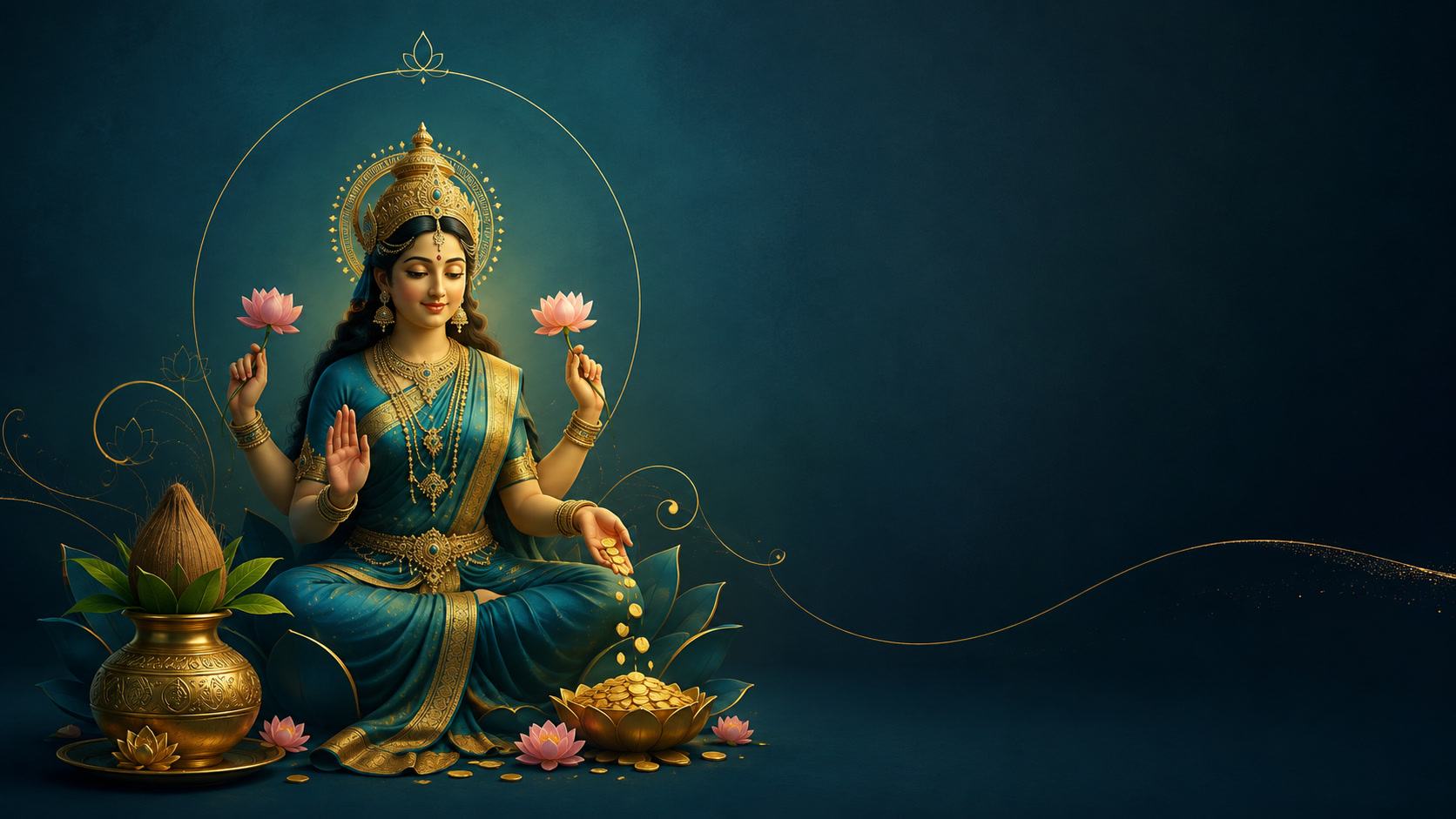
Varalakshmi Vratam
Varalakshmi Ammavaru · About 38 minutes · 17 steps
When is it?
The vidhanam at a glance
Dates are computed by our own panchangam engine, which matches the TTD Srivari calendar to the minute.
A simple home Varalakshmi puja, step by step at your own pace — listen, do, and one touch moves you on. The ashtottaram, thoram and katha play right here in the priest's voice.
Friday morning after bathing; about an hour end to end.
The full vidhanam
Getting ready in the morning
- Bathe early and wear clean clothes
- Clean the puja space
- Draw the muggu and ready the puja peeta
- Spread a new cloth on the peeta
- Ready the kalasham plate with rice
Preparing the kalasham
- Apply turmeric and kumkuma to the kalasham
- Fill the kalasham with water
- Add akshintalu, coins, betel nut and other mangala dravyas per your family's way
- Tie turmeric thread around the kalasham's neck
- Arrange the mango leaves
- Place the turmeric-smeared coconut on top
- Tie the cloth / blouse piece
- If using amma's face (mukham), fix it now
- Set the kalasham on the rice-filled plate
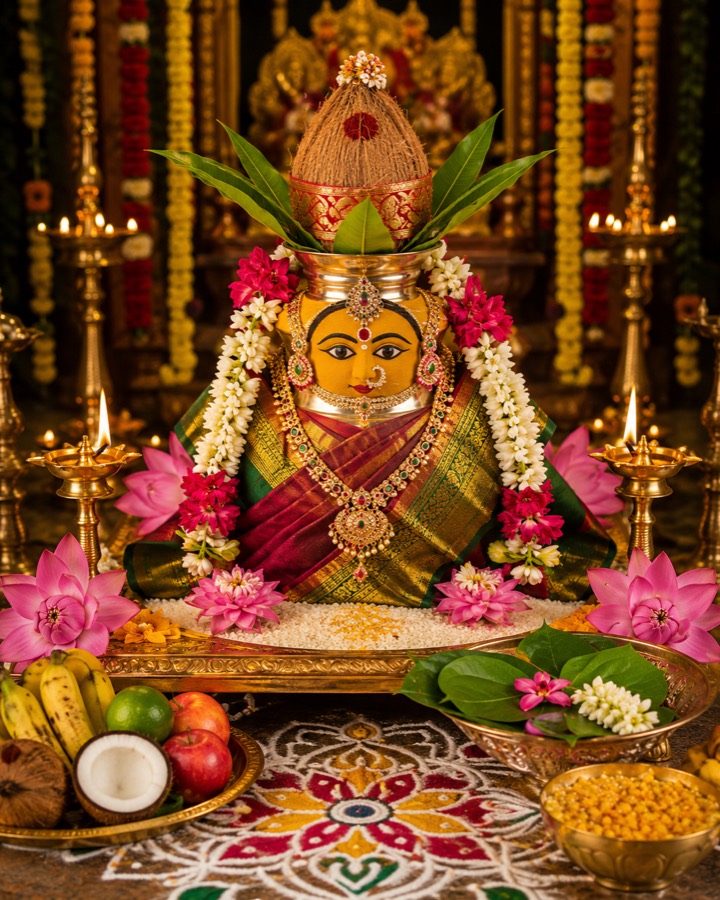
The dravyas placed in the kalasham vary by family tradition.
Light the lamps
- Light the lamps and recite this shloka
Shlokaśuklāṃbaradharaṃ viṣṇuṃ śaśivarṇaṃ caturbhujaṃ | prasannavadanaṃ dhyāyet sarvavighnopaśāṃtaye ||
Achamanam
- Take a little water and do achamanam
Shlokaoṃ keśavāya namaḥ oṃ nārāyaṇāya namaḥ oṃ mādhavāya namaḥ
Ganapati puja
- Place the pasupu Ganapati or a Vinayaka idol
- Worship with turmeric, kumkuma, akshintalu and flowers
- Offer naivedyam
Shlokavakratuṃḍa mahākāya sūryakoṭi samaprabha | nirvighnaṃ kurume deva sarvakāryeṣu sarvadā ||
Every auspicious beginning starts with Vinayaka.
Sankalpam
- Declare the sankalpam — that you perform this vratham for amma's grace, the family's wellbeing, health, long life and prosperity.
Invoking amma
- Meditate, invoking Varalakshmi amma into the kalasham — feel her seated in your puja mandir, and begin with devotion.
- Offer turmeric and kumkuma
- Offer sandal paste
- Offer akshintalu
- Offer flowers
- Offer cloth, bangles and mangala dravyas per your family's way
Angapuja & ashtottaram
- Do angapuja with flowers / akshintalu
- Recite or listen to the ashtottara shatanamavali, offering flowers or akshintalu with each name
Bangaru rupu pujaOptional
- Place any one gold item you have at home near amma
- If there is none — a turmeric piece, a coin, or a betel leaf is enough
- Worship it with turmeric, kumkuma and flowers
This step is optional. Nothing is missing from the vratham without gold — amma looks at the devotion, not the metal.
Did you know?
Elders say gold holds shakti — it takes in the glow of the consecrated amma and keeps it in our home all year. And there's one more lovely thought: whatever gold we have is amma's grace anyway. Placing what she gave us back at her feet — saying "amma, all this is because of you" — that is the real beauty of our sanatana way.
Thoram puja
- Tradition worships the thoram's 9 knots, one name each — offer a flower or akshintalu at every knot:
Shlokaoṃ kamalāyai namaḥ — prathamagraṃthiṃ pūjayāmi oṃ ramāyai namaḥ — dvitīyagraṃthiṃ pūjayāmi oṃ lokamātre namaḥ — tṛtīyagraṃthiṃ pūjayāmi oṃ viśvajananyai namaḥ — caturthagraṃthiṃ pūjayāmi oṃ mahālakṣmyai namaḥ — paṃcamagraṃthiṃ pūjayāmi oṃ kṣīrābdhitanayāyai namaḥ — ṣaṣṭhagraṃthiṃ pūjayāmi oṃ viśvasākṣiṇyai namaḥ — saptamagraṃthiṃ pūjayāmi oṃ caṃdrasahodaryai namaḥ — aṣṭamagraṃthiṃ pūjayāmi oṃ harivallabhāyai namaḥ — navamagraṃthiṃ pūjayāmi
After the 9 knots, tie the thoram on the wrist per your family's way.
The vratam katha
- Read or listen to the vratam katha
- After the katha, offer namaskaram to amma
Offering naivedyam
- Place the prepared naivedyams before amma and offer with devotion
Shlokaoṃ mahālakṣmī devyai namaḥ — naivedyaṃ samarpayāmi
Vayanam · thamboolam for amma
- Offer the prepared vayanam / thamboolam to amma
Shlokaoṃ mahālakṣmī devyai namaḥ — tāṃbūlaṃ samarpayāmi
Dhoopam, deepam & harathi
- Offer the flowers
- ఓం మహాలక్ష్మీ దేవ్యై నమః — పుష్పం సమర్పయామి
- Show the dhoopam
- ఓం మహాలక్ష్మీ దేవ్యై నమః — ధూపం సమర్పయామి
- Show the deepam
- ఓం మహాలక్ష్మీ దేవ్యై నమః — దీపం సమర్పయామి
- Give the camphor harathi
- ఓం మహాలక్ష్మీ దేవ్యై నమః — హారతి సమర్పయామి
- The whole family offers namaskaram to amma
Thamboolam for muthaidhuvulu
- After the puja, give thamboolam to the muthaidhuvulu and take their blessings
Prasadam
- Share amma's prasadam with family, relatives and the muthaidhuvulu
After the puja
- When to move the kalasham, how to use the coconut and the kalasham water — these vary by family and region.
- Your home's generations-old tradition always comes first.
Puja checklist
🪔 Everyday puja items
- Turmeric
- Kumkuma
- Sandal paste
- Akshintalu
- Camphor
- Incense sticks / dhoop
- Cotton wicks
- Ghee / lamp oil
- Lamp stands / pramidalu
- Plate for the lamps
- Bell
- Panchapatra and uddharini
- Harathi plate
- Water vessel for puja
- Naivedyam bowls
The everyday-puja staples — the must-buys.
🌸 Flowers, fruits, leaves
- Loose flowers
- Flower garland
- Betel leaves — 15–25
- Betel nuts
- Mango leaves
- Tulasi / sacred leaves
- Coconuts — 2–3
- Bananas
- Other fruits — 4–5 kinds
🪙 Special for the vratam
- Lakshmi photo or small idol
- Gold coin / pendant (bangaru rupu) — a turmeric piece or a coin is enough if you don't have one
- Thread
🛕 Puja peeta
- Puja peeta (low wooden seat)
- New cloth to spread on the peeta
- Rice to spread under the kalasham
- Rice flour for muggu
- Small plates for pasupu, kumkuma, gandham, akshintalu
- Plate to place the kalasham
🪷 Varalakshmi kalasham
- Kalasham — silver, copper or brass
- Inside: water, akshintalu, coins, betel nut, turmeric — per family custom
- Mango leaves — 5 or more
- Coconut to place on the kalasham
- Turmeric thread to tie the kalasham
- Flowers / garland
- New cloth / blouse piece for the coconut
✨ Decoration
- Varalakshmi amma face (mukham)
- Small saree / cloth for amma
- Small jewellery / decoration items
- Nallapusalu / mangalasutram
- Bangles
- Braid / flower decoration
All optional — decorate with what your home already has.
🧵 Thoram
- Vratam thoram — 9-strand turmeric thread with 9 knots
- Flowers to tie on the thoram
- Thread the bangaru rupu onto the thoram
🎁 Vayanam for amma
- Betel leaves
- Betel nuts
- Turmeric and kumkuma
- Fruit
- Flowers
- Bangles
- Saree with blouse piece
- Dakshina
If it's your family's tradition, a small mirror, comb and kajal are also placed.
👩🦳 Thamboolam for muthaidhuvulu
- Betel leaves
- Betel nuts
- Turmeric and kumkuma
- Fruit
- Bangles
- Flowers
- Blouse piece
- Prasadam
🍚 Naivedyam
- Pulihora
- Paramannam / payasam
- Boorelu / poornam boorelu
- Garelu
- Chalimidi
- Vadapappu
- Panakam
- Daddojanam (curd rice)
- Fruits
- Coconut
- Jaggery
- Banana leaves / plates for prasadam
You don't need all of these — 2 to 4 main naivedyams, per your family's custom, is plenty.
📿 During the puja
- Vinayaka idol / turmeric for pasupu Ganapati
- Varalakshmi vratam katha (in this app, 📖 tile)
- Ashtottara shatanamavali
- Lakshmi stotralu
🏠 The day before
- Clean the house and puja space
- Gather all puja items in one place
- Clean the kalasham, lamps and silver
- Ready the naivedyam staples — dals, rice, jaggery, ghee
- Soak black chana and dals
- Plan amma's decoration ahead
- Pack the thamboolams ahead
📖 Vratam katha
Long ago, Suta maharshi spoke thus to Saunaka and the munis: O saints! Parama Siva himself told Parvati devi of a vratham that showers soubhagya — prosperity — upon women. For the benefit of the world I shall tell you of that vratham. Hear it carefully.
One day, as Parameswara sat on his simhasana, Parvathi devi approached him and asked: "O swami, tell me of a vratham by which women gain every comfort, flourish through children and grandchildren, and attain moksha." Siva replied: "O Devi! There is one vratham that gives women all prosperity — it is the Varalakshmi vratam."
It should be performed, he said, on the Friday that comes before the pournami — the full-moon day — of Sravana masam.
Then Parvathi devi asked: "Deva! Who first performed this Varalakshmi vratham? Tell me in detail how it is to be done." "Katyayani! Once, in the land of Magadha, there was a city named Kundina nagaram. In that city lived a woman named Charumathi — virtuous, obedient and patient. She rose early every day, served her husband and her in-laws, and lived in friendship with her neighbours."
One night, Varalakshmi devi appeared in Charumathi's dream. "Charumathi! Worship me on the Friday before the full moon of Sravana masam, and I shall grant the boons and gifts you ask," she said, and disappeared. Charumathi rejoiced: "O Mother! Blessed are those who receive your grace — they live honoured, prosperous and learned. O Pavani! By the merit of my past lives I have been given your darshanam." Thus she praised Lakshmi in many ways.
Waking, Charumathi knew it for a dream, and told it to her husband and her in-laws. Overjoyed, they encouraged her to perform the Varalakshmi vratam. The women of the city, hearing of her dream, also began waiting for that auspicious Friday before the pournami.
On that Sravana Friday, all the women of the city rose at dawn, bathed, dressed in silk, and gathered at Charumathi's house. Charumathi arranged a mandapam in her home, poured rice upon it and set the kalasam on top, invited Varalakshmi devi into the kalasam with sankalpam, and worshipped her with the sixteen upacharas, offering naivedyams. They tied the thoram — the sacred thread of nine strands — to their hands, and offered pradakshina namaskarams to Varalakshmi devi.
As they completed the first pradakshina, anklets rang out on their feet. At the second, their hands shone with gem-studded golden bangles. At the third, every one of them stood adorned in full ornament.
By the fruit of that Varalakshmi vratam, Charumathi's home — and the homes of all the women of that city — filled with wealth, gold and every good thing. Chariots with elephants and horses came from their own houses to carry them home, and all along the way they praised Charumathi: the devi had appeared in her dream, and by her vratam she had made them all greatly fortunate. Every year thereafter they performed the Varalakshmi vratam, lived in prosperity and happiness, and attained mukti.
O munis — this is the vratham that Paramasiva taught Parvati. By hearing this story, by performing this vratham, or even by watching it performed, one gains all wealth, health, fortune and prosperity — so said Suta maha muni to Saunaka and the maharshis.
After hearing this story, place a few akshatas at Lakshmi devi's feet and a few upon your head. Then give thamboolams to the muthaidhuvulu, distribute theertham and prasadam to all — and those who performed the puja should take them too. This vratham may be done by anyone, of any community or tradition. Pray with bhakthi, and mother Varalakshmi devi surely blesses you.
Ashtottara shatanamavali
Read the full namavali (109)
oṃ prakṛtyai namaḥ
oṃ vikṛtyai namaḥ
oṃ vidyāyai namaḥ
oṃ sarvabhūta hitapradāyai namaḥ
oṃ śraddhāyai namaḥ
oṃ vibhūtyai namaḥ
oṃ surabhyai namaḥ
oṃ paramātmikāyai namaḥ
oṃ vāce namaḥ
oṃ padmālayāyai namaḥ (10)
oṃ padmāyai namaḥ
oṃ śucaye namaḥ
oṃ svāhāyai namaḥ
oṃ svadhāyai namaḥ
oṃ sudhāyai namaḥ
oṃ dhanyāyai namaḥ
oṃ hiraṇmayyai namaḥ
oṃ lakṣmyai namaḥ
oṃ nityapuṣṭāyai namaḥ
oṃ vibhāvaryai namaḥ (20)
oṃ adityai namaḥ
oṃ dityai namaḥ
oṃ dīptāyai namaḥ
oṃ vasudhāyai namaḥ
oṃ vasudhāriṇyai namaḥ
oṃ kamalāyai namaḥ
oṃ kāṃtāyai namaḥ
oṃ kāmākṣyai namaḥ
oṃ kṣīrodasaṃbhavāyai namaḥ
oṃ anugrahaparāyai namaḥ (30)
oṃ buddhaye namaḥ
oṃ anaghāyai namaḥ
oṃ harivallabhāyai namaḥ
oṃ aśokāyai namaḥ
oṃ amṛtāyai namaḥ
oṃ dīptāyai namaḥ
oṃ lokaśoka vināśinyai namaḥ
oṃ dharmanilayāyai namaḥ
oṃ karuṇāyai namaḥ
oṃ lokamātre namaḥ (40)
oṃ padmapriyāyai namaḥ
oṃ padmahastāyai namaḥ
oṃ padmākṣyai namaḥ
oṃ padmasuṃdaryai namaḥ
oṃ padmodbhavāyai namaḥ
oṃ padmamukhyai namaḥ
oṃ padmanābhapriyāyai namaḥ
oṃ ramāyai namaḥ
oṃ padmamālādharāyai namaḥ
oṃ devyai namaḥ (50)
oṃ padminyai namaḥ
oṃ padmagaṃdhinyai namaḥ
oṃ puṇyagaṃdhāyai namaḥ
oṃ suprasannāyai namaḥ
oṃ prasādābhimukhyai namaḥ
oṃ prabhāyai namaḥ
oṃ caṃdravadanāyai namaḥ
oṃ caṃdrāyai namaḥ
oṃ caṃdrasahodaryai namaḥ
oṃ caturbhujāyai namaḥ (60)
oṃ caṃdrarūpāyai namaḥ
oṃ iṃdirāyai namaḥ
oṃ iṃduśītalāyai namaḥ
oṃ āhlādajananyai namaḥ
oṃ puṣṭyai namaḥ
oṃ śivāyai namaḥ
oṃ śivakaryai namaḥ
oṃ satyai namaḥ
oṃ vimalāyai namaḥ
oṃ viśvajananyai namaḥ (70)
oṃ tuṣṭaye namaḥ
oṃ dāridryanāśinyai namaḥ
oṃ prītipuṣkariṇyai namaḥ
oṃ śāṃtāyai namaḥ
oṃ śuklamālyāṃbarāyai namaḥ
oṃ śriyai namaḥ
oṃ bhāskaryai namaḥ
oṃ bilvanilayāyai namaḥ
oṃ varārohāyai namaḥ
oṃ yaśasvinyai namaḥ (80)
oṃ vasuṃdharāyai namaḥ
oṃ udārāṃgāyai namaḥ
oṃ hariṇyai namaḥ
oṃ hemamālinyai namaḥ
oṃ dhanadhānya karyai namaḥ
oṃ siddhaye namaḥ
oṃ straiṇasaumyāyai namaḥ
oṃ śubhapradāyai namaḥ
oṃ nṛpaveśmagatāyai namaḥ
oṃ naṃdāyai namaḥ (90)
oṃ varalakṣmyai namaḥ
oṃ vasupradāyai namaḥ
oṃ śubhāyai namaḥ
oṃ hiraṇyaprākārāyai namaḥ
oṃ samudra tanayāyai namaḥ
oṃ jayāyai namaḥ
oṃ maṃgal̤āyai devyai namaḥ
oṃ viṣṇu vakṣaḥsthala sthitāyai namaḥ
oṃ viṣṇupatnyai namaḥ
oṃ prasannākṣyai namaḥ (100)
oṃ nārāyaṇa samāśritāyai namaḥ
oṃ dāridrya dhvaṃsinyai namaḥ
oṃ sarvopadrava vāriṇyai namaḥ
oṃ navadurgāyai namaḥ
oṃ mahākāl̤yai namaḥ
oṃ brahma viṣṇu śivātmikāyai namaḥ
oṃ trikāla jñāna saṃpannāyai namaḥ
oṃ bhuvaneśvaryai namaḥ (108)
iti śrīlakṣmyaṣṭottaraśatanāmāval̤i samāptam.
Why do we celebrate?
In the Skanda Purana, Varalakshmi appears in the dream of a devoted woman named Charumati, asking to be worshipped on a Shravana Friday — a vratam Shiva himself narrated to Parvati.
Skanda Purana
She is 'the Lakshmi who grants boons' — and Telugu households have long held that this one puja carries the blessings of all eight Lakshmis.
Telugu tradition
How to celebrate
- Set up the kalasham with coconut and blouse cloth to welcome the Goddess
- Tie the toram — a turmeric thread with nine knots
- Pulihora and poornam boorelu as naivedyam
- Invite muthaiduvulu and offer tambulam
- Remember: devotion over decoration — a small heartfelt puja is complete
This whole festival began with one dream — Charumati's. Centuries later, we're still celebrating it. Never underestimate a good dream!
Frequently asked questions
When is Varalakshmi Vratam?
Friday, 13 August 2027.
Why is Varalakshmi Vratam observed?
In the Skanda Purana, Varalakshmi appears in the dream of a devoted woman named Charumati, asking to be worshipped on a Shravana Friday — a vratam Shiva himself narrated to Parvati. (Skanda Purana)
How is Varalakshmi Vratam performed?
• Set up the kalasham with coconut and blouse cloth to welcome the Goddess • Tie the toram — a turmeric thread with nine knots • Pulihora and poornam boorelu as naivedyam • Invite muthaiduvulu and offer tambulam • Remember: devotion over decoration — a small heartfelt puja is complete
What is needed for Varalakshmi Vratam?
The checklist has 88 items in all, grouped as Everyday puja items · Flowers, fruits, leaves · Special for the vratam · Puja peeta · Varalakshmi kalasham · Decoration · Thoram · Vayanam for amma · Thamboolam for muthaidhuvulu · Naivedyam · During the puja · The day before.
How long does the Varalakshmi Vratam puja take?
About 38 minutes, across 17 steps.